
Suzuki A100 Specs, Top Speed, Mileage, Picture, Diagram & History
Introduction
The Suzuki A100 occupies a special place in the story of small-displacement motorcycling. Produced from the late 1960s through much of the 1970s (with regional variations in production years), it was never intended to be glamorous or revolutionary. Yet, in many parts of the world—from Asia and Europe to Africa—it became a trusted companion for commuters, delivery riders, and first-time motorcyclists.
At a time when lightweight two-stroke machines dominated entry-level markets, the A100 offered simplicity, affordability, and surprising durability. Its 98cc engine delivered lively performance for urban use, while its straightforward mechanical layout made it accessible to riders with limited technical experience. In countries where mobility meant opportunity, the A100 was more than a motorcycle—it was economic freedom on two wheels.
Today, the A100 enjoys renewed interest among vintage enthusiasts. Not because it was exotic, but because it represents an era when motorcycles were uncomplicated, mechanical, and honest. In the broader history of Suzuki’s two-stroke development, the A100 stands as a humble yet important milestone in the brand’s global expansion.
 |
| suzuki a100 |
Historical Background
To understand the A100, one must look at Suzuki Motor Corporation during the 1960s. Suzuki had established itself as a serious force in two-stroke engineering. The company’s experience in small-capacity racing and commuter motorcycles gave it a clear technical direction: lightweight, efficient, and affordable machines for mass mobility.
The A100 was introduced as part of Suzuki’s growing lineup of small-displacement street bikes. It evolved from earlier 100cc class models, filling the gap between mopeds and larger 125cc machines. In many markets, licensing and taxation laws favored sub-100cc motorcycles, making the A100 a practical choice.
Competition during its era was fierce. Honda’s four-stroke commuters, Yamaha’s lively two-strokes, and Kawasaki’s small-capacity offerings all competed in the same space. The A100’s main rivals included machines like the Honda CB100 and Yamaha RS100. While Honda emphasized four-stroke reliability and refinement, Suzuki leaned into the punchy character and mechanical simplicity of the two-stroke.
Though the A100 did not have a direct racing pedigree, Suzuki’s broader racing success in the 50cc and 125cc classes during the 1960s helped shape the engineering philosophy behind it. Lightweight frames, responsive engines, and simple tuning potential were part of the company’s DNA.
Culturally, the A100 became deeply embedded in developing markets. In South Asia, Southeast Asia, and parts of Africa, it was often the first motorcycle owned by a family. In the UK, it served as a popular learner-legal machine. Its global footprint far exceeded its modest specifications.
Design & Engineering
The Suzuki A100 used a simple tubular steel backbone frame. It was neither exotic nor particularly innovative, but it was strong enough for daily abuse and easy to repair if damaged. The layout was conventional: single-cylinder engine as a stressed member, twin rear shocks, and telescopic front forks.
Styling was understated. Early models featured slim fuel tanks with chrome side panels, flat dual seats, and minimal bodywork. Later variants adopted slightly more angular tanks and brighter paint schemes in keeping with 1970s trends. The A100 never tried to look like a race replica—it looked practical, and that was intentional.
Build quality was generally solid for its class. Switchgear was basic but functional. Chrome quality varied depending on production year and market destination, and some export versions showed cost-cutting measures. However, the core mechanical components were robust.
Unique design elements included Suzuki’s CCI (Crankcase Cylinder Injection) oil injection system on many versions. This eliminated the need for pre-mixing fuel and oil, a significant convenience at the time. For a small commuter motorcycle, this feature gave the A100 a technological edge over some competitors.
Engine & Performance (Realistic Analysis)
At the heart of the A100 was a 98cc air-cooled, single-cylinder, two-stroke engine. It typically produced around 9–11 horsepower depending on the market and tuning specification.
Power delivery was characteristic of small two-strokes: modest torque at low rpm, building steadily into a lively mid-range surge. It was not explosive, but it felt eager. In city traffic, the engine’s responsiveness made it easy to keep pace with larger vehicles. The lightweight chassis amplified this sensation.
Top speed generally hovered around 80–95 km/h (50–60 mph) under ideal conditions. For a commuter motorcycle of its era, this was entirely adequate.
The riding experience was mechanical and engaging. Vibrations were present but tolerable. The exhaust note had the familiar sharp crackle of a small two-stroke. Clutch action was light, and gear shifts—typically via a 4-speed gearbox—were positive though not particularly refined.
Mechanical strengths:
-
Simple engine architecture
-
Reliable oil injection system (when maintained)
-
Good cooling due to modest power output
-
Easy access for servicing
Weaknesses:
-
Piston and ring wear if poorly lubricated
-
Carburetor sensitivity to dirt and poor fuel
-
Electrical system aging issues (points ignition)
-
Exhaust carbon buildup common in two-strokes
When properly maintained, the engine was surprisingly durable. Many examples ran for decades in daily use.
Real-World Ownership Experience
Maintenance Difficulty
The A100 is mechanically simple. Routine maintenance—spark plug replacement, carburetor cleaning, chain adjustment—can be performed with basic tools. Points ignition requires periodic adjustment, but the system is straightforward.
Spare Parts Availability
Globally, parts availability depends heavily on region. In South Asia and parts of Africa, reproduction parts are still widely available due to the bike’s long service life. In Europe and North America, sourcing may require specialist vintage suppliers or online marketplaces.
Consumables such as cables, pistons, and gaskets are generally obtainable. Cosmetic parts (original tanks, side panels, badges) are more difficult to find in good condition.
Reliability
When maintained, the A100 is dependable. The oil injection system must be kept functional—bypassing it and running pre-mix is common but not always ideal.
Electrical reliability can suffer due to aging wiring harnesses and corroded connectors. However, these issues are typical for motorcycles of this age.
Common Mechanical Problems
-
Worn piston rings leading to reduced compression
-
Carbon-clogged exhaust systems
-
Weak or inconsistent spark due to worn points
-
Oil pump misadjustment
-
Rusted fuel tanks
Fuel Efficiency
In real-world historical context, the A100 delivered impressive fuel economy—often 35–45 km per liter (80–100 mpg UK equivalent), depending on riding style. For many owners, this was one of its greatest strengths.
7. Restoration Guide
Is It Easy to Restore?
Mechanically, yes. Cosmetically, it can be more challenging.
The engine is simple to rebuild, and there are no complex electronics. A full engine overhaul is well within the capability of a competent home mechanic.
Parts Sourcing Tips
-
Search for region-specific suppliers in countries where the A100 was popular.
-
Join vintage Suzuki owner clubs and forums.
-
Consider compatible parts from related Suzuki models of the same era.
Common Restoration Challenges
-
Finding original exhaust systems without corrosion
-
Locating authentic decals and badges
-
Rechroming parts economically
-
Repairing rusted fuel tanks
Estimated Restoration Cost Range
Costs vary widely by country. A light recommissioning may require modest investment. A full cosmetic and mechanical restoration—especially with professional paint and chrome—can exceed the motorcycle’s market value. Enthusiasts often restore A100s for sentimental reasons rather than profit.
8. Collector Value & Market Price (Global)
The A100 is not rare globally, but clean, original examples are becoming less common.
Current Market Trends
In the UK and parts of Asia, interest in 1970s commuter motorcycles is growing. Auction platforms occasionally feature restored examples, though the A100 typically trades through private sales rather than high-profile auctions.
Approximate Price Range
-
Project bikes: Low hundreds (USD equivalent)
-
Running examples: Mid hundreds to low thousands
-
Fully restored, original-condition bikes: Higher, but rarely exceeding modest four-figure sums
Investment Potential
The A100 should not be viewed primarily as a financial investment. Its value lies in nostalgia and historical significance. Gradual appreciation is possible, especially for well-preserved original bikes.
Rarity Level
Moderate. Many were produced, but attrition from heavy daily use has reduced surviving numbers.
9. Comparison with Similar Era Models
Compared to the Honda CB100, the A100 feels lighter and more responsive, though less refined. The Honda’s four-stroke engine offers smoother power delivery and less exhaust smoke.
Against the Yamaha RS100, the A100 is similar in performance. Yamaha’s engine often felt slightly sharper at higher rpm, while Suzuki’s oil injection system earned praise for reliability.
In essence, the A100 represented a balanced middle ground—neither the most powerful nor the most sophisticated, but consistently dependable.
10. Pros and Cons
Pros
-
Lightweight and easy to ride
-
Simple, easy-to-service engine
-
Good fuel economy
-
Strong nostalgic appeal
-
Affordable entry into vintage ownership
Cons
-
Modest performance by modern standards
-
Drum brakes require careful adjustment
-
Two-stroke smoke and emissions
-
Cosmetic parts can be difficult to source
-
Limited long-distance comfort
11. Who Should Buy This Motorcycle Today?
The Suzuki A100 is ideal for:
-
Collectors of small-displacement Japanese classics
-
Enthusiasts seeking a simple restoration project
-
Riders who appreciate mechanical simplicity
-
Those with personal or regional nostalgia tied to the model
It is less suited for riders seeking highway capability or modern braking performance. The A100 is best enjoyed on relaxed backroads or urban settings where its lightweight agility shines.
FAQs
1. When was the Suzuki A100 produced?
Primarily from the late 1960s through the 1970s, with regional variations.
2. How fast is a Suzuki A100?
Top speed is generally between 80–95 km/h depending on condition.
3. Is the Suzuki A100 reliable?
Yes, when properly maintained. Oil injection and ignition systems require regular attention.
4. Is it difficult to restore a Suzuki A100?
Mechanically straightforward; cosmetic restoration can be more challenging.
5. Are Suzuki A100 parts still available?
Yes, though availability varies by region. Reproduction and used parts are common in some countries.
6. What fuel economy does the Suzuki A100 achieve?
Typically 35–45 km per liter under normal riding conditions.
7. Is the Suzuki A100 a good investment?
It offers modest appreciation potential but is best valued for enjoyment rather than profit.
8. How does it compare to the Honda CB100?
The A100 is lighter and more lively; the CB100 is smoother and more refined.
Suzuki A100 Carburetor Main Jet Size
Suzuki A100 Carburetor Needle Jet
Suzuki A100 Carburetor throttle Valve CutAway
Suzuki A100 Carburetor Pilot Jet Size
Suzuki A100 Carburetor Air Adjusting Screw
Suzuki A100 Carburetor Starter Jet Size
Suzuki A100 Idle speed
Suzuki A100 Automatic lubrication
Suzuki A100 Throttle Cable Freeplay
Suzuki A100 Clutch Lever Free Play
Suzuki A100 Front Brake Lever Adjusting
Suzuki A100 Rear Brake Lever Adjusting
Suzuki A100 Chain Adjusting
Suzuki A100 Contact Point Gap
Suzuki A100 Fuel Consumption
25-30 kmpl. (Avg.).Suzuki A100 Tire Pressure
Front Tire Pressure is 22 psi and The Rear Tire Pressure is 28 psi.Suzuki A100 Spark Plug Gap
0.6-0.7 millimeters (mm) or 0.024-0.028 inches.Suzuki A100 Photos
 |
| suzuki a100 1966 |
 |
| suzuki a100 1969 |
 |
| suzuki a100 1972 |
 |
| suzuki a100 1975 |
 |
| Suzuki A100 Original Key |
 | |
| Suzuki A100 Advertising Picture |
 |
| Suzuki A100 Advertising Poster |
Suzuki A100 Wiring Diagram
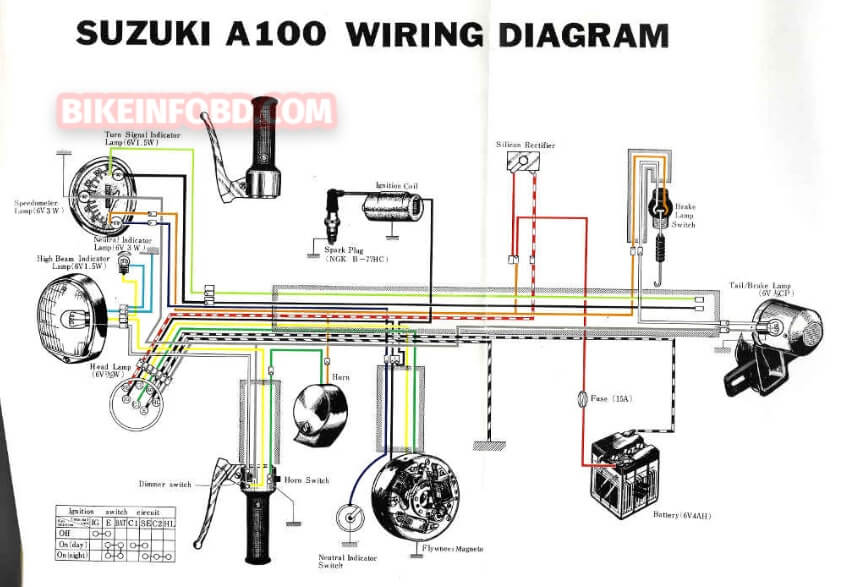 |
| suzuki a100 wiring |
Suzuki A100 Owner Service Manuals
Suzuki A100 Manuals PDFSuzuki A100 Technical Specifications
| More Specification | |
|---|---|
| Bike Brand | Suzuki |
| Model Name / Also called | Suzuki A100 |
| Predecessor | Suzuki A80 |
| Model Year / Production | 1966 - 76 |
| Bike Type / Class | Naked |
| Brand Origin | Japan |
| Engine | |
|---|---|
| Engine Type | 100cc, Two stroke, single cylinder, rotary disc valve, aluminum |
| Displacement (cc) | 98 cc / 5.9 cu-in |
| Maximum Power | 7.1 kW / 9.5 hp @ 7500 rpm |
| Maximum Torque | 9.3 Nm / 0.95 kgf-m / 6.87 lb-ft @ 6500 rpm |
| Ignition | CB Point |
| Bore & Stroke | 50 x 50 mm |
| Starting | Kick Starter |
| Cooling System | Air-cooled |
| Compression Ratio | 6.5:1 |
| Brakes | |
|---|---|
| Brakes | Drum |
| Front Brake | Drum |
| Rear Brake | Drum |
| Wheels and Tyres | |
|---|---|
| Front Tire Size | 2.50-18 4PR |
| Rear Tire Size | 2.50-18 4PR |
| Dimension and Weight | |
|---|---|
| Seat height | 770 mm |
| Overall height | 1,010 mm |
| Overall length | 1,830 mm |
| Overall width | 760 mm |
| Ground Clearance | 140 mm |
| Dry weight | 82 kg |
| Curb Weight | 94 kg |
| Mileage and Performance | |
|---|---|
| 0-100 Kmph | |
| Top Speed | 65-75 Mph (104-120 kmpl) (avg.) |
| Fuel Capacity | 7 L |
| Fuel economy | 25-30 kmpl (Avg) |
| Consumption Average | |
| Fuel Type | Petrol |
| Fuel Supply | Mikuni VM18 Carburetor |
| 2T Oil Capacity |
1.2 L |
| Recommended Oil | JASO FC |
| Features Value and Safety | |
|---|---|
| Speedometer | Analog |
| Tachometer | |
| Tripmeter |
| Electricals and Transmission | |
|---|---|
| Number of Used Plugs | 1 |
| Spark Plug | NGK B8HS or B9HS |
| Battery | |
| Voltage | 6v |
| Head Light | Yes |
| Tail Light | Yes |
| Gear Box | 4-speed |
| Final Drive | Chain |
| Clutch | Wet, multi-plate |
| Chain Size | 420 |
| Chassis and Suspension | |
|---|---|
| Front Suspension | Twin shocks |
| Rear Suspension | Swingarm, twin shocks, springs |
| Frame type | Pressed steel |
| More Specification | |
|---|---|
| Bike Colours | Candy Topaz Orange,Candy Lavender,Candy Blue,Candy Jade Green,Candy Gold |
| No. of Cylinders | 1 cylinder |
Suzuki A100 Top Speed and Acceleration Video
Final Verdict
The Suzuki A100 is not a legend in the traditional sense. It did not win famous races or redefine engineering standards. Yet its importance lies elsewhere. It was dependable transportation for countless riders across the globe. It embodied the practical genius of small-displacement two-stroke design during a transformative period in motorcycling.
For collectors, it represents authenticity. For restorers, it offers mechanical simplicity. For former owners, it carries memories of first rides, first jobs, and early independence.
In the crowded field of classic motorcycles, the A100 stands quietly. It may never command high auction prices, but its value is measured differently—in durability, accessibility, and the enduring charm of a straightforward machine built to serve its rider honestly.

I had one of these in 1973, my first bike. On L plates there was no speed restrictions so I let her go. For 10 miles I flattened myself on the Tank and saw 75mph. I miss my A100 it got185 miles to the gallon of fuel even on that fast run out to Alexandra Victoria.
ReplyDelete